Case study · Australia
AI-powered legacy report reviews for exploration teams
We use large language models on top of our processed national report archive to help explorers find, summarise and prioritise the historical reports, and the pages, that matter most to their ground.
- 0.5M Exploration reports catalogued Linked to tenements and companies
- 5.4M OCR pages of report text
- 0.9M AI-generated file summaries
- 90M Embedded passages for semantic search Rounded from an exact count
The challenge
Most of what has ever been learned about a piece of Australian ground sits in statutory exploration reports. For any project area there can be hundreds of them, many scanned, some decades old, and the critical drill results, sample descriptions or interpretations are buried on a handful of pages. Reading everything is impractical; skimming risks missing the one report that matters.
Our approach
Large language models are improving quickly and now make first-pass summarisation, discrete data extraction and agentic review workflows practical. We apply them on top of a report archive we have already processed at national scale, so a review starts from searchable text rather than from raw scans. Geologists set the questions and review the answers: the AI does the first pass, people make the calls.
Data and methods
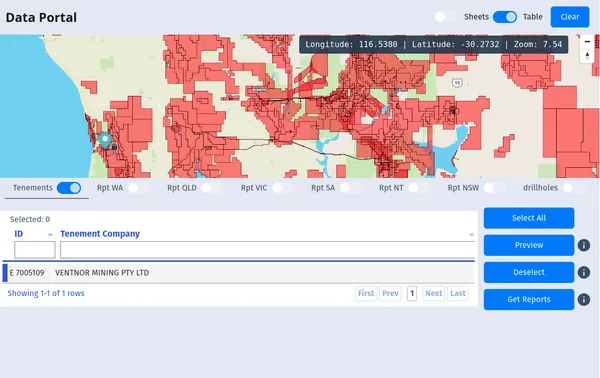
- Archive: a national catalogue of statutory exploration reports, linked to tenements, companies and report geometries.
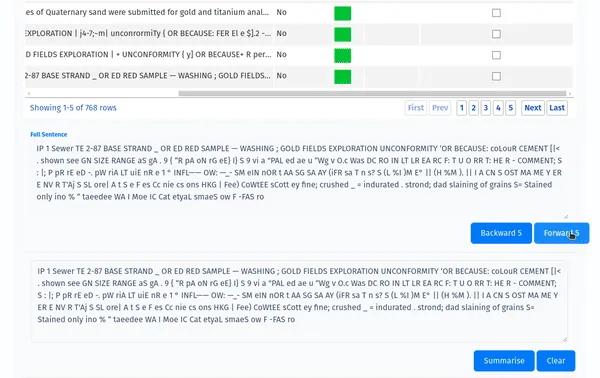
- Text: OCR page text and extracted full text for each processed report file.
- Summaries: an AI-generated summary per file for triage.
- Search: spatial filtering to the area of interest, then semantic search (by meaning) and full-text search (by exact phrase) across embedded passages.
- Extraction: targeted extraction of discrete data, such as drilling and sampling details, from the reports that rank highest.
Results
The review platform runs over roughly half a million catalogued reports, about 5.4 million OCR pages and nearly 900,000 AI-generated file summaries, with more than 90 million passages embedded for semantic search. Clients can move from an area of interest to a ranked, summarised reading list without opening every report first.
Impact
Teams get better insight from historical reports and can identify and prioritise the most critical reports and information before committing geologist time. Results specific to individual clients are confidential.
Deliverables
- Ranked reading lists of relevant reports for a project area
- Per-report summaries and highlighted passages
- Extracted data tables from priority reports
- Access to search for follow-up questions
Work with us
Have a stack of historical reports, or a new project area to understand? See how our historical report reviews work or talk to us.